

🪙 For roughly a century, the operating assumption in neuroscience was simple: electrical stimulation excites neurons. You deliver current, nearby cells depolarize, and you get activity. The only question was how much activity and where.
🚫 That assumption is wrong. Or rather, it is far too simple, and the oversimplification has shaped the design of every therapeutic stimulation device currently in clinical use.
🔎 Here’s what we found. When you deliver electrical pulses to the brain through a microelectrode, you don’t just activate nearby neurons. At certain frequencies and temporal patterns, you inhibit neural network activity. Not individual neurons, the biophysics of direct cathodic stimulation make it nearly impossible to inhibit a single cell with an extracellular electrode. But networks? Networks can absolutely be inhibited, through a mechanism that exploits something the field had been overlooking: inhibitory neurons.
🛑 Inhibitory interneurons, particularly the parvalbumin-expressing fast-spiking type, can sustain firing rates above 100 Hz. Excitatory neurons typically cannot reliably fire above 15-20 Hz. When you deliver high-frequency stimulation, you preferentially drive inhibitory networks. If you then pause at the right moment, while excitatory neurons are in their absolute refractory period, the inhibitory drive suppresses excitatory activity during the pause. The result is a net reduction in network output, inhibition, achieved through stimulation.
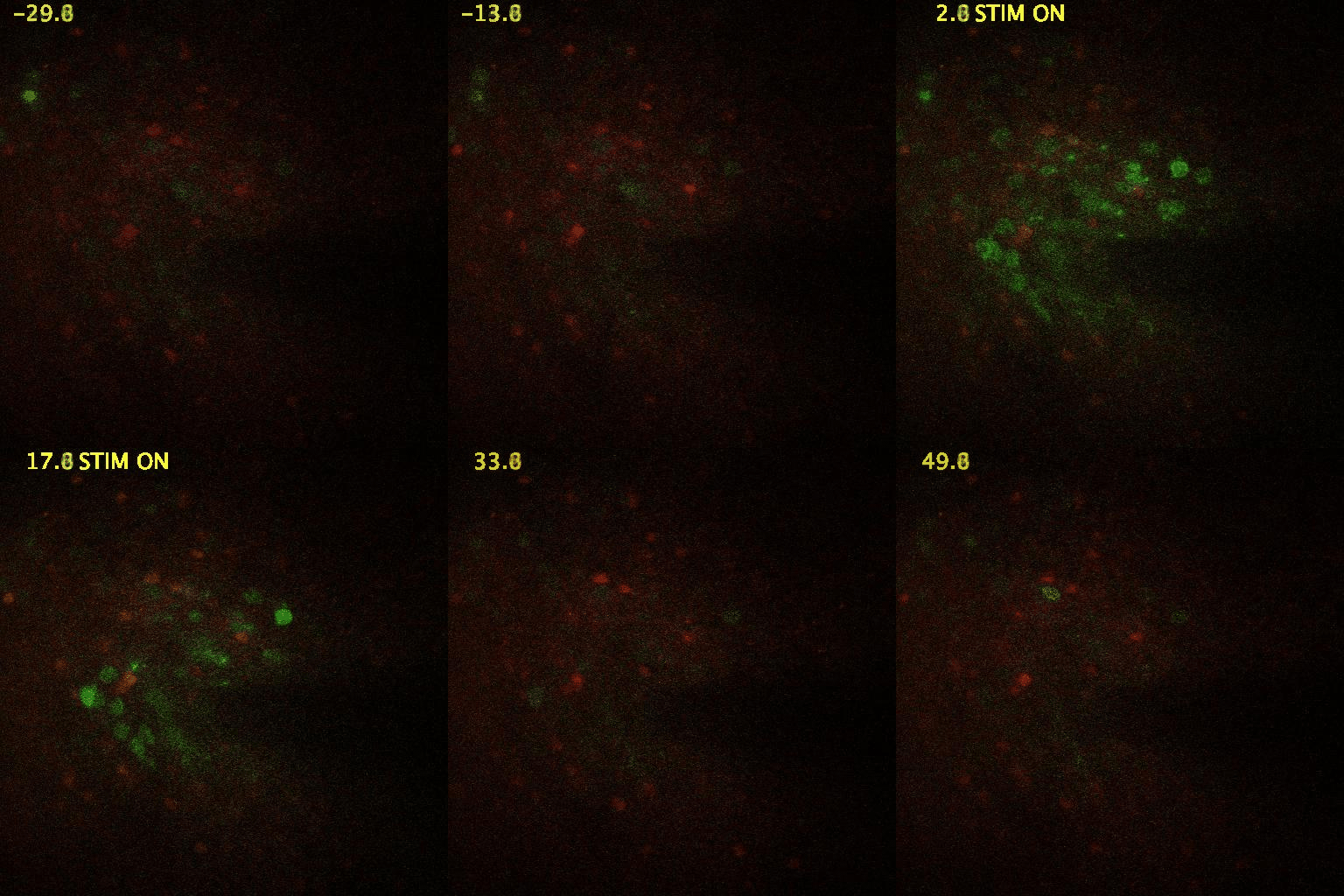
We demonstrated this using in vivo two-photon calcium imaging, watching the activity of individual labeled neurons in living mouse cortex during and after stimulation. The finding overturned dogma that had stood unchallenged since the early 20th century.
The finding has direct clinical relevance. Depression, epilepsy, schizophrenia, and chronic pain all involve excitation-inhibition imbalances. If stimulation can be used not just to activate but to selectively suppress overactive circuits, the therapeutic possibilities expand considerably.
It also explains something BCI users know experientially but researchers struggled to account for: that the sensation evoked by electrical stimulation fades. The inhibitory recruitment we identified is one mechanism underlying that fading, and understanding it is the first step toward designing stimulation patterns that sustain perception rather than letting it decay.
More to come.
Review: https://lnkd.in/enHUqypN
Inhibitory: https://lnkd.in/ecFihBRm
Temporal Pattern:https://lnkd.in/dXkpMmQ
Freq: https://lnkd.in/e2d39Dvc
Waveform: https://lnkd.in/e-2b4Jq5
Biomimitic: https://lnkd.in/gm2x_AgM
#Neuroscience #Neuromodulation #BrainStimulation #Neurotechnology #BrainComputerInterface