
🔬 Five Biological Questions That Stand Between Today's BCI and a Lifetime Device
Why BCIs Fail Series: Post 21

💥 In 1969, physicist Robert Wilson was asked whether the particle accelerator he wanted to build had any value for national defense.
His answer: “It has nothing to do directly with defending our country except to help make it worth defending.”
🧬 I think about that line often when people ask me why I study glial cells and blood vessels instead of building brain-computer interfaces.
🦠 The answer is the same. The basic biology is what makes the devices worth building.
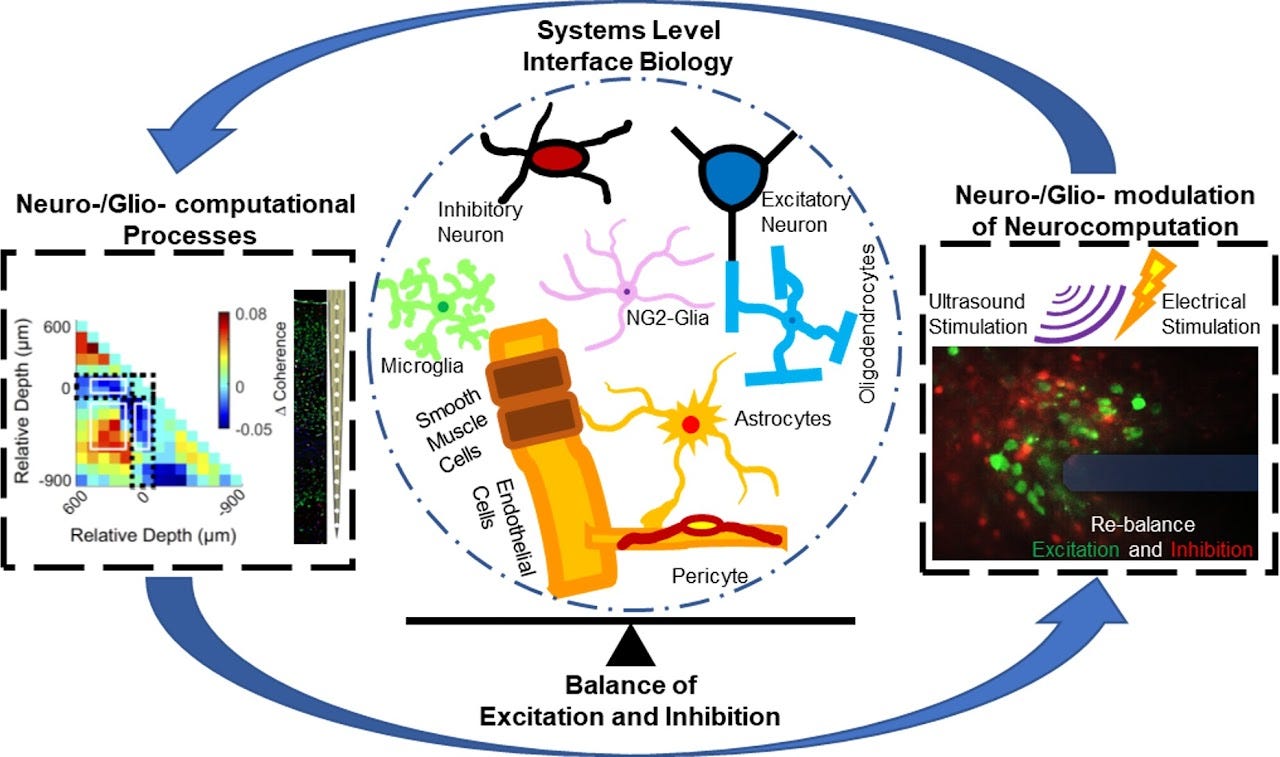
📅 Over the course of this series, I’ve walked through what actually happens when you put an electrode in the brain. Insertion trauma that severs capillaries and tears through the neuropil. An immune response that never resolves. Glial cells that wall off the device. A neurovascular unit that reorganizes around a wound it cannot close. Neurons that die, migrate, or simply stop talking to the electrode.
⚙️ None of these problems can be engineered around. They must be understood first.
🔬 That understanding comes from basic science. The kind funded by NIH, pursued in academic labs, published in journals most people will never read. It is slow work. It does not generate headlines or Series B valuations. It generates knowledge, the kind that determines whether a neural interface lasts five weeks or fifty years.
🦅 Wilson was asked if his accelerator would keep the country competitive. He said it had to do with whether we were good painters, good sculptors, great poets. “All the things that we really venerate and honor in our country and are patriotic about.”
🚸 Then he was asked about priorities and hungry children.
🚚 He agreed that feeding children comes first. But he added that it is also important to get on with the things that make life worth living. And he warned that if we falter, “I can see the whole effort dispersed and lost.”
🛣️ That warning applies to neural engineering today. The trainees who would characterize chronic glial dynamics or map neurovascular remodeling at implant sites need funded labs to work in. If those grants don’t come, those people retrain. The knowledge they would have generated simply will not exist. And every BCI company building on a biological foundation they assume someone else will maintain will eventually hit a wall that no amount of engineering capital can move.
🧪 The question was never whether basic science matters. The question is whether we will still be funding it when the runway ends.
⚠️ Fund the science that explains why brain-computer interfaces fail. That is how you build ones that don’t.
Review: https://www.nature.com/articles/s41551-017-0154-1Review: https://advanced.onlinelibrary.wiley.com/doi/abs/10.1002/adfm.201701269
Review: https://www.nature.com/articles/s41551-025-01583-6
Review: https://pubs.acs.org/doi/full/10.1021/cn500256e
Perspective: https://iopscience.iop.org/article/10.1088/1741-2552/ae54cf
#neurotech #BCI #NIH #basicscience #neuroscience #braincomputerinterface #WhyBCIsFail