
🧱 Your Brain Implant Isn't Failing at the Electrode. It's Failing in the Blood Vessels.
Why BCIs Fail Series: Post 13

💥 The BCI field has spent decades focused on what happens at the electrode surface: scar tissue, immune cells, coating chemistry. That focus made sense. But our data show that the real bottleneck might be 50-100 microns away, inside blood vessels that nobody was monitoring.
🔬 Your brain has its own plumbing system. Capillaries deliver oxygen and fuel to neurons, and wrapped around them are mural cells, pericytes and smooth muscle cells that act as valves, opening and closing to direct blood where it’s needed. Without them, the brain has no way to route fuel to active regions.
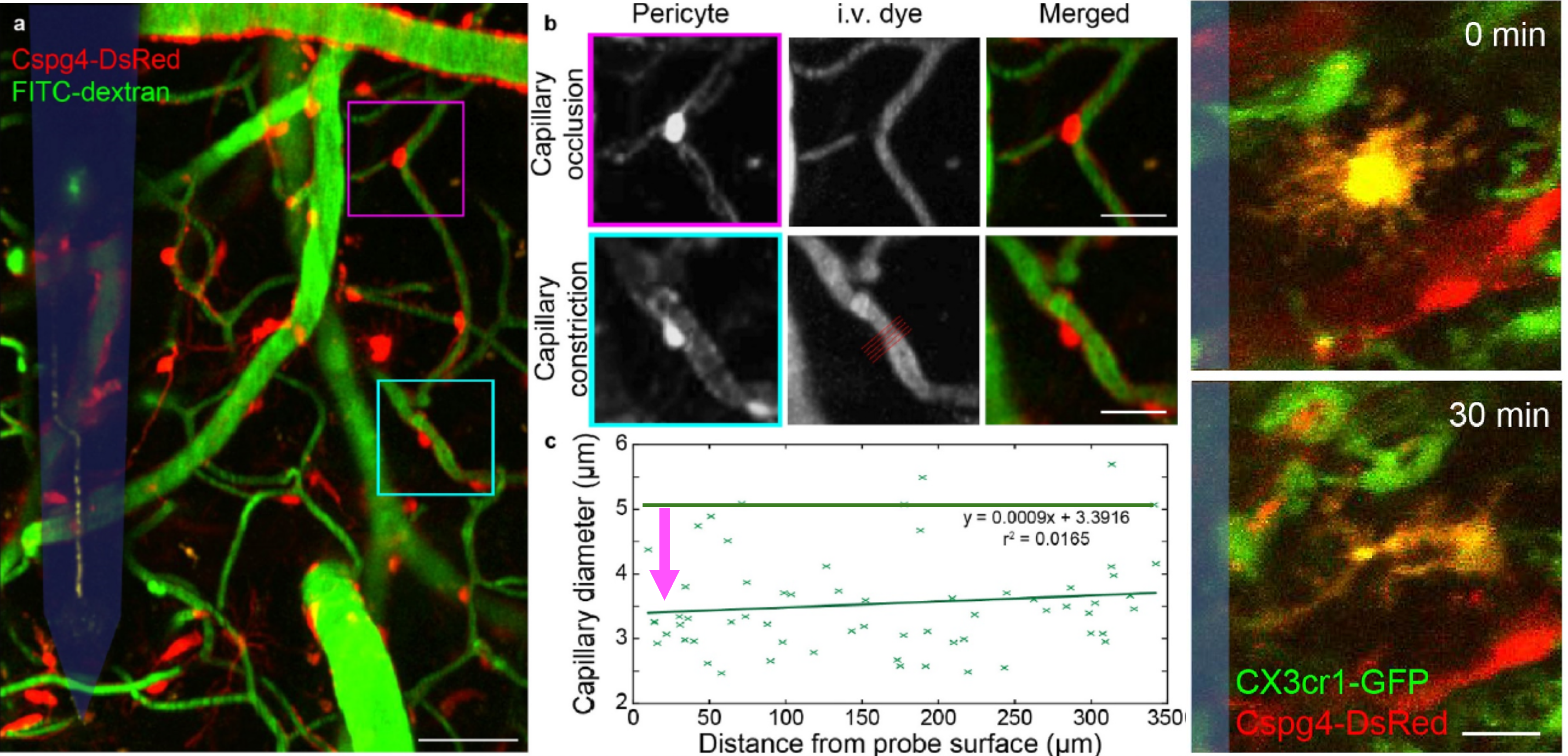
🚨 When an electrode is implanted, pericytes near the device constrict, squeezing capillaries shut. Blood flow to nearby neurons drops. Not because vessels were destroyed during insertion, but because the biological valves controlling flow clamped down in response to injury and stayed shut.
📊 We tracked individual pericytes on individual capillaries for weeks after implantation using two-photon microscopy. The mural cells didn’t just react once and recover. They changed structurally over time, shifting their shape, position, and grip on the vessels they regulate. Some that initially constricted never fully relaxed. Others migrated away from their normal positions along the capillary wall. The blood supply restriction wasn’t a one-time injury. It was an evolving problem that worsened even as the initial insertion wound healed.
🧠 This matters because neurons are energy hogs that can’t stockpile fuel. When blood flow drops even modestly, they lose the ability to sustain activity. They don’t die. They go quiet, rationing energy the way any system does when supply is constrained (Post 5 on the energy crisis).
🔗 Connect this to the timeline from earlier posts. The electrode severs vessels on insertion (Post 1). Immune cells swarm within hours (Post 3). Oligodendrocytes that keep neurons metabolically efficient are damaged within days (Post 4). Now we’re showing that the vascular cells responsible for restoring blood flow are themselves compromised for weeks. Each layer of the response compounds the last.
🔧 The device might be fine. The wiring might be fine. But the power grid went down. If we want implants that last decades, we need strategies that protect the brain’s plumbing, not just its circuitry.
Mural cells: https://www.sciencedirect.com/science/article/pii/S0142961224004988
Energy crisis: https://bioniclab.substack.com/p/the-energy-crisis-nobody-talks-about
Review: https://iopscience.iop.org/article/10.1088/1741-2552/ae54cf/
#Neuroscience #Neurotechnology #BrainComputerInterface #Bioengineering #BrainHealth