

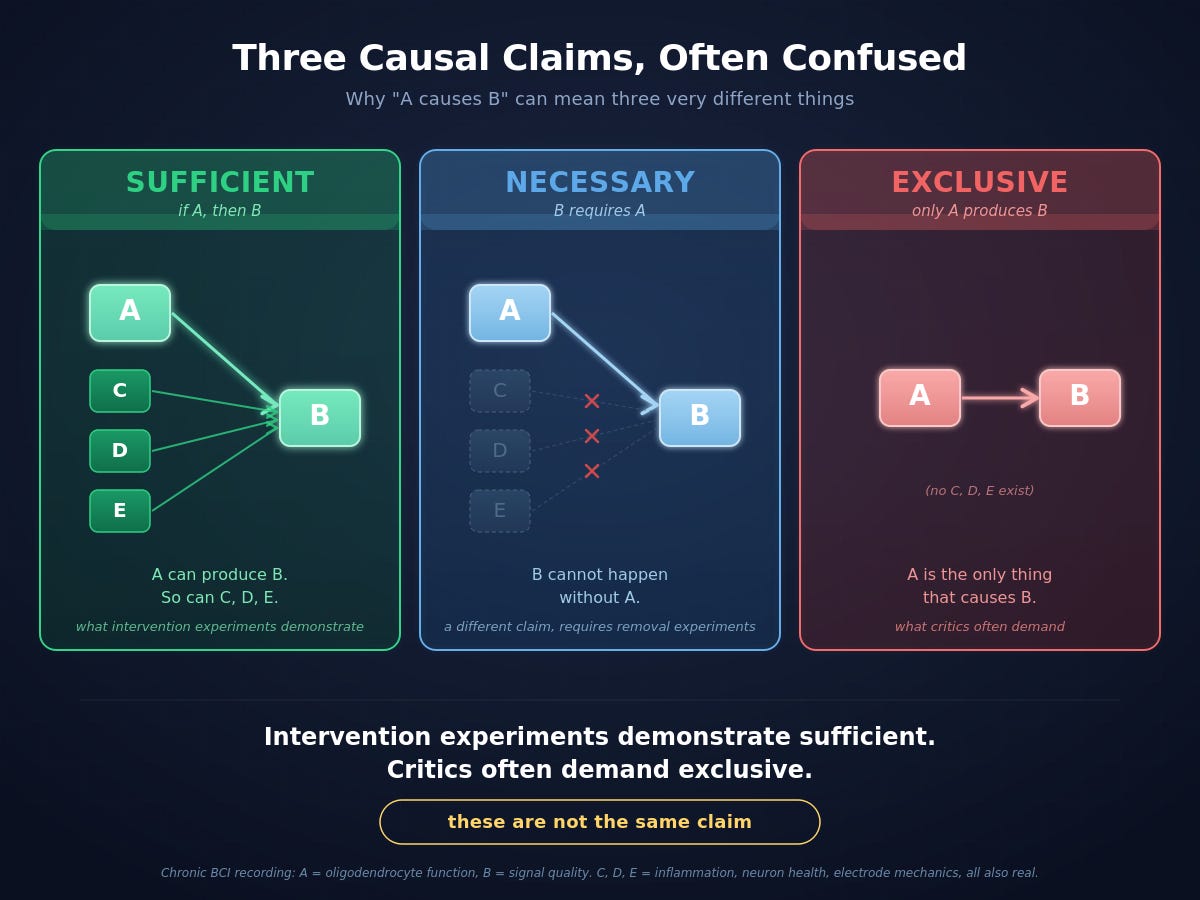
A common pattern across engineering-and-biology conversations in BCI translation runs like this. Investigator demonstrates that mechanism A is sufficient to drive outcome B, with an intervention experiment that perturbs A and watches B change. Critic responds, “you have not shown A is the only cause, B also depends on C, D, E.” Investigator agrees that C, D, E matter. Critic concludes the experiment proves nothing.
⚡ The confusion is between three distinct logical operators. Sufficiency, if A, then B. Necessity, B requires A. Exclusivity, only A produces B. Most intervention experiments demonstrate sufficiency. Almost no one claims exclusivity, because biology rarely runs through a single pathway. But engineers trained on system identification often treat sufficiency claims as exclusivity claims, because in a well-characterized linear system, finding one input-output transfer function is supposed to be the answer.
🔬 Biological systems do not work that way. Multiple independent pathways can produce the same phenotype. Sir Austin Bradford Hill made this explicit in the 1965 Proceedings of the Royal Society of Medicine paper that founded modern causal inference in medicine (link below), arguing that intervention evidence should be weighed against the reality of multiple causes rather than held to a standard of demonstrating sole causation.
📊 The cost of confusing sufficiency with exclusivity is measurable. For chronic intracortical recording, the field has spent over two decades targeting neuron protection (anti-inflammatory coatings, softer materials, smaller electrodes) on the assumption that neuron death drives signal loss. Recent genetic-perturbation work shows that oligodendrocyte metabolic support gates recording quality at chronic-implant inflammatory baseline, independent of neuron loss. Inflammation matters. Neuron death matters. Oligodendrocyte function matters. They are not the same variable, and intervention on any of them can change the recording outcome.
🔧 The translational question is not “what is the unique cause” but “what is a tractable intervention point.” Sufficient cause is not the cause. It is a cause. Demonstrating that A is sufficient says A is an axis you can move to change the output, which is what therapeutic strategy actually requires.
🇺🇸 The decades-long mistargeting of BCI intervention strategy comes not from bad science but from a logical category error that Hill warned against sixty years ago. Sufficient cause is not the cause. It is a cause. That distinction is worth recovering.
Hill 1965 (free): https://www.ncbi.nlm.nih.gov/pmc/articles/PMC1898525/
#WhyBCIsFail #Neuroscience #BrainComputerInterface #CausalInference #NeuralEngineering